Radon mitigation built around Sioux Falls basements
Systems are designed to bring the home below the EPA action level, and a post-installation test verifies the result.
What a mitigation system actually does
Radon rises out of the soil and takes the easiest path it can find. Under most Sioux Falls homes, that path leads through the basement floor: slab cracks, the sump pit, the gap where the slab meets the wall. A mitigation system wins by offering an easier path. A suction point goes through the slab, a fan pulls soil gas up a pipe, and the gas vents above the roofline before it ever gets indoors.
That’s the whole trick. The gas still forms under the house. It just never builds up inside it.
Housing here gives the work a familiar shape. Most of the city sits on full basements, with poured or block walls, a slab floor, and often a sump pit in the corner. The newer edges of the metro add walkouts and split-foyers, and some additions and older homes sit over a crawlspace instead. Each foundation changes where a system pulls from, which is why the work starts by looking at the house.
The honest frame matters, so here it is. Systems are designed to bring a home below the EPA action level of 4 picocuries per liter. No one can promise a specific number before the work is done, and you should be wary of anyone who does. What a good job does promise is proof: a follow-up test after installation that shows the level came down. That retest is part of the work, not an add-on.
Why the foundation decides the design
The standard approach for a basement home is sub-slab suction. A hole goes through the concrete floor, a pit gets hollowed out beneath it, and a pipe carries soil gas from that pit up and out. One suction point handles most houses. A large footprint, an addition on its own slab, or tight soil under the concrete can call for a second.
Houses with a sump pit sometimes offer a shortcut. The drain tile feeding the pit already reaches around the foundation, so sealing the pit and pulling from it can move air under the whole slab at once. Whether that beats a slab penetration is a judgment call made at the house, not from a website.
Two other cases come up often enough around Sioux Falls to have their own pages. Homes over a dirt or gravel crawlspace usually need a sealed liner with suction under it. That’s crawlspace mitigation, and it’s different enough work to read about separately. And many newer homes in the metro were built with a passive radon pipe already in the walls. Those usually don’t need a full install, just a fan added to the existing rough-in.
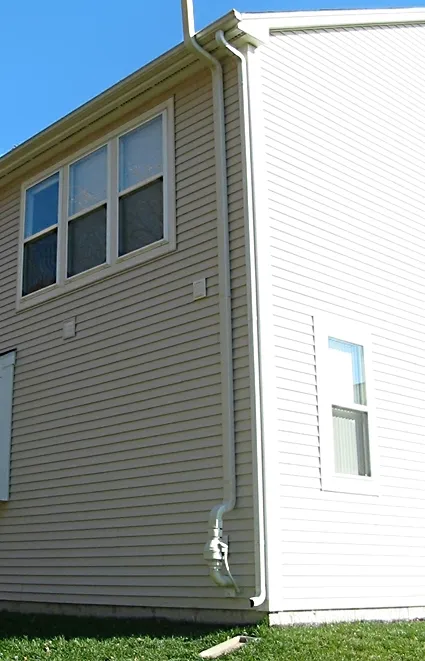
What no assessment-first outfit will do is commit to pipe routing, fan placement, or noise levels sight unseen. In most cases the pipe runs up through a garage or closet chase, or up an exterior wall. Which one fits your house is exactly what the assessment answers.
How a mitigation job usually runs
- 1
Look at the house
Foundation type, layout, sump pit, and any test results shape what gets proposed.
- 2
Set the design
Suction point and pipe route are matched to how the home is built.
- 3
Install the system
The suction point, pipe run, fan, and gauge go in.
- 4
Retest
A follow-up test confirms the level came down below the action level.
The retest is the product
Anyone can mount a fan on a pipe. What you’re actually buying is a lower number in your own basement, and there’s only one way to know you got it: test again after the system is running.
Industry practice is to retest no sooner than 24 hours after startup, and the result belongs in writing. If the number didn’t come below the action level, the system gets adjusted (a stronger fan, a second suction point) until it does. That’s why the retest isn’t a courtesy. It’s the standard the whole job is measured against.
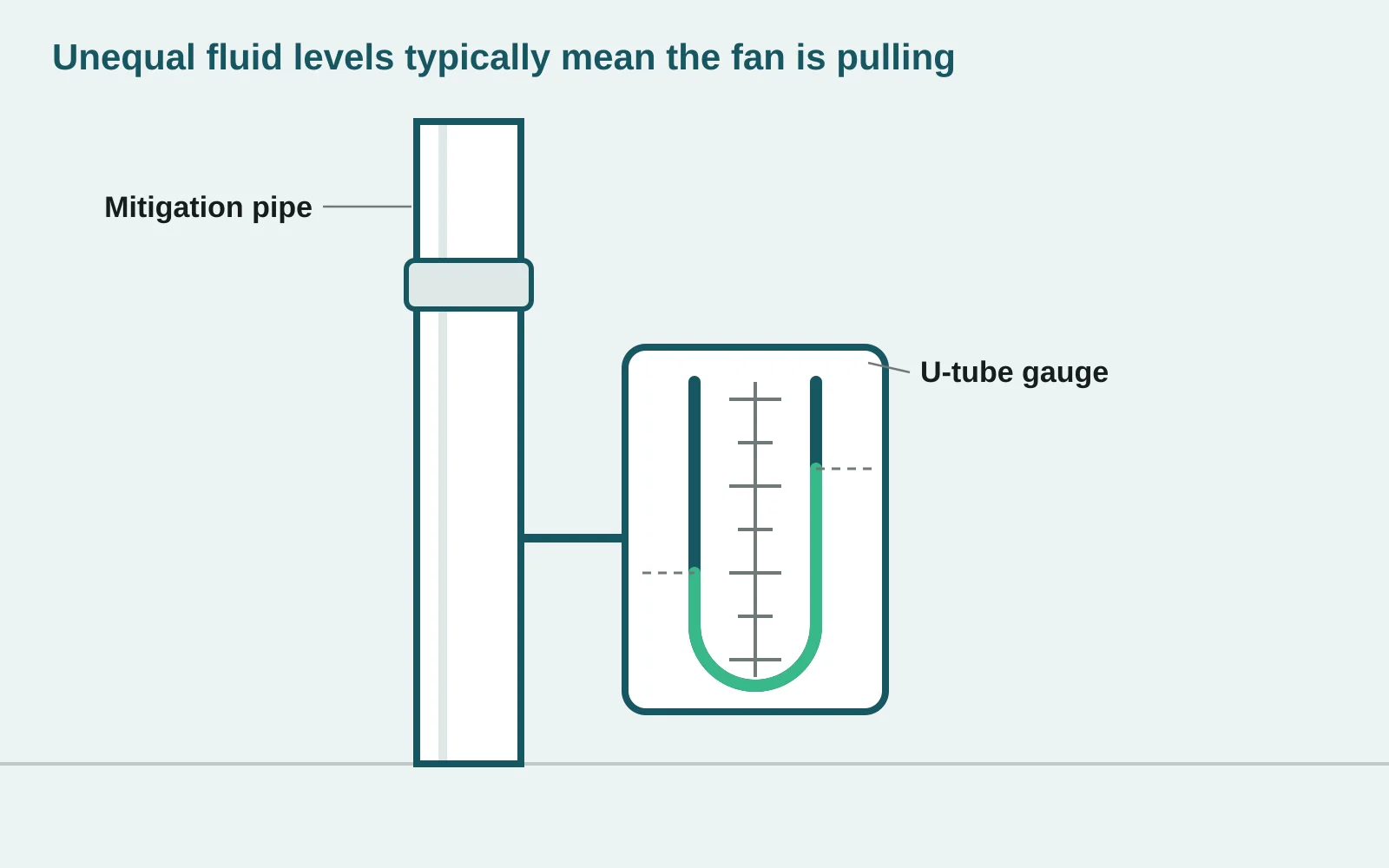
After that, the u-tube gauge on the pipe becomes your day-to-day check. Uneven fluid means the fan is pulling. Level fluid means it isn’t, and the system needs attention. A minute with that gauge, plus a retest every couple of years, is all the monitoring a homeowner needs. There’s a plain-English walkthrough at is my radon system working? if you already have a system and aren’t sure.
Start with an assessment, not a guess over the phone
The scale mitigation is measured against
Under 2 pCi/L
- EPA guidance
- Low for an occupied home
- Where mitigation fits
- Retest every few years
2 to 4 pCi/L
- EPA guidance
- Consider fixing the home
- Where mitigation fits
- Mitigation is optional but effective
4 pCi/L or more
- EPA guidance
- Fix the home
- Where mitigation fits
- Mitigation, then a verifying retest
| Test result | EPA guidance | Where mitigation fits |
|---|---|---|
| Under 2 pCi/L | Low for an occupied home | Retest every few years |
| 2 to 4 pCi/L | Consider fixing the home | Mitigation is optional but effective |
| 4 pCi/L or more | Fix the home | Mitigation, then a verifying retest |
Radon is measured in picocuries per liter (pCi/L). The EPA action level is 4 pCi/L.
Where to go from here
If you’re still deciding whether your number calls for a system at all, start with what radon levels actually mean. The scale is short, with 4 picocuries per liter as the action line, but the context around it is worth five minutes.
If the number surfaced during a home purchase, the calendar is the real constraint. Radon in a home sale covers how testing, mitigation, and the verification paperwork fit inside a closing timeline.
And if you already have a system that’s gone quiet or whose gauge reads level, the fan is the usual suspect. They run 24 hours a day and wear out on a roughly decade-long cycle. Fan replacement is quicker work than a new install, and it brings the system back to doing its one job.
Frequently Asked Questions
Will a system get my house below a specific number?
Systems are designed to bring the home below the EPA action level of 4 picocuries per liter, and most end up well under it. Nobody honest quotes an exact number before the work is done. The post-installation test is what verifies the result.
How disruptive is the installation?
Less than most people expect. Typical residential work means one hole through the slab, a pipe run, and a fan mounted outside or in the attic. Foundation type and layout drive the scope, so what's involved gets confirmed at the assessment.
Where will the pipe and fan go?
It depends on the house. Some systems run up through a garage or utility chase, others up an exterior wall. Routing follows the foundation, the framing, and code, and the options get walked through before anything is drilled.
How long does the fan last?
Radon fans run continuously, and in industry experience most last on the order of a decade. The gauge on the pipe is usually how owners find out one has stopped. Replacement is routine work.
Does a radon system help or hurt resale?
A system with a documented retest is a routine item in home sales around here. Many buyers in a high-radon area see it as a plus, because the problem is already solved and provable on paper.
Can't I just seal the cracks instead?
EPA guidance is clear that sealing alone doesn't reliably hold levels down. Sealing is part of many jobs, but the fix that works is active mitigation — pulling the gas from under the house before it gets in.