High radon in Sioux Falls is a fixable problem
Testing shows where your home stands, and mitigation systems are proven by a follow-up test after installation.
Start where you are
-
Your test came back high
You have a number in hand and want to know what it means and what fixing it involves. This guide walks through both.
Read more -
Buying, selling, or just want to know
Radon in a home sale runs on the deal's timeline. Testing and mitigation can be scheduled around a closing.
Read more
Testing, mitigation, and help with a high result
Radon mitigation in Sioux Falls, SD is straightforward work. A gas rises out of the ground, collects in the house, and a system pulls it back out. You can’t see or smell radon, and public-health agencies tie long-term exposure to lung cancer. That sounds alarming. The useful news is that it’s one of the most fixable problems a house can have.
The path is well-worn. A test tells you the level. If the number is high, a mitigation system draws the gas from under the house and vents it above the roof, and a second test confirms the level came down. What mitigation involves is covered in plain terms on its own page, and so is radon testing.
Systems are designed to bring a home below the EPA action level of 4 picocuries per liter. Nobody honest promises a specific number before the work is done. The retest after installation is the proof, and it’s part of the job, not an extra.
Most people get here one of three ways. A home inspection turned up a number. A hardware-store kit came back high. Or a neighbor put in a system and got them wondering about their own basement. All three are normal, and none of them means something is wrong with the house itself. Radon comes from the ground under the home, not from anything anyone did. If you’re holding a result right now, start with what a high test means.
Our Services
-
Radon Mitigation
A mitigation system collects the gas beneath the home and vents it safely above the roofline — before it can build up indoors.
Learn more
-
Radon Testing
Radon can't be seen or smelled — a test is the only way to know a home's level.
Learn more
-
Radon for Home Sales
Radon findings in a purchase usually come with a deadline attached — the process works better when someone's done it on a closing schedule before.
Learn more
-
Radon Fan Replacement & System Repair
Mitigation fans run continuously for years — and like anything that runs continuously, they eventually wear out.
Learn more
-
Passive Radon System Activation
Many newer homes were built with a passive radon rough-in — a pipe that's ready for a fan but doesn't have one yet.
Learn more
-
Crawlspace Radon Mitigation
Homes over crawlspaces need a different approach — typically a sealed membrane over the exposed soil, tied into the venting system.
Learn more
-
Commercial & Multifamily Radon
Schools, workplaces, and multifamily buildings test and mitigate at a different scale, often with compliance documentation attached.
Learn more
-
Radon in Well Water
In some regions, well water carries radon into the home when it runs — a separate problem with separate treatment approaches.
Learn more
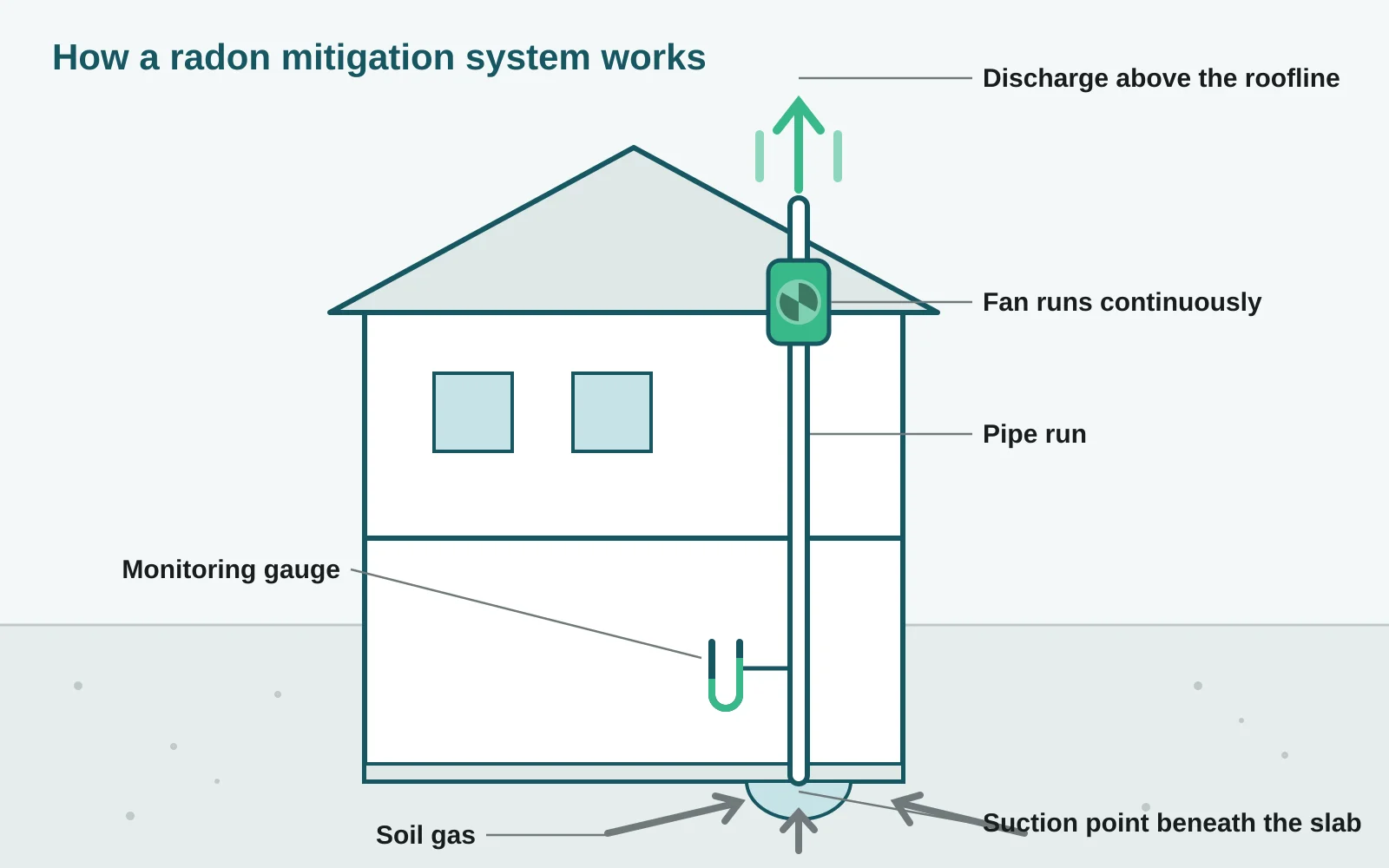
What a mitigation system looks like
What a radon test number means
Below 2 pCi/L
- What EPA guidance says
- Low for a lived-in home
- Typical next step
- Retest every few years
2 to 4 pCi/L
- What EPA guidance says
- Consider fixing the home
- Typical next step
- Confirm with a follow-up test
4 pCi/L and above
- What EPA guidance says
- At the action level; fix the home
- Typical next step
- Plan mitigation, then verify by retest
| Test result | What EPA guidance says | Typical next step |
|---|---|---|
| Below 2 pCi/L | Low for a lived-in home | Retest every few years |
| 2 to 4 pCi/L | Consider fixing the home | Confirm with a follow-up test |
| 4 pCi/L and above | At the action level; fix the home | Plan mitigation, then verify by retest |
This scale comes from EPA consumer guidance. Radon is measured in picocuries per liter (pCi/L), and 4 pCi/L is the EPA action level.
How radon mitigation works in a Sioux Falls house
The work runs in three moves: design, install, verify.
Design starts with the house itself. A full basement, a crawlspace, a sump pit, an addition on its own slab. Each one changes where a system can pull from, so the assessment reads the foundation before anything gets proposed.
The system itself is simple to picture. A suction point goes through the slab, or under a sealed liner if the home sits over a crawlspace. A pipe carries the soil gas up and releases it above the roofline. A fan keeps the air moving around the clock, and a small gauge on the pipe shows the suction is holding. Once the design is set, most residential installs are quick jobs, though the house has the final say.
Verification is the part worth being picky about. A system should bring the house below the action level, and the post-installation test is what shows it actually happened. Not a claim on a website. A number from your own basement. The gauge then tells you, at a glance, that the system is still pulling years later.
The full guide to how radon mitigation works walks through each piece with pictures. And if you’re still deciding whether your number calls for a system at all, what radon levels mean puts the scale in plain English.
How a mitigation project usually goes
- 1
Assessment
The foundation, layout, and any test results shape the plan.
- 2
System design
The approach is matched to how the house is built.
- 3
Installation
Suction point, pipe run, fan, and gauge go in.
- 4
Verification
A post-installation test confirms the level came down.
Have a number you're not sure about, or a house that's never been tested?
Either way, an estimate is a conversation, not a commitment.
Why basements around here test high
The upper Midwest tests high for radon more often than most of the country, and southeast South Dakota sits squarely in that pattern. The reason is under our feet. Glaciers ground across this region and left deep beds of till, the crushed rock and soil they carried. Those deposits hold traces of uranium. Uranium breaks down over time, and radon is one step in that breakdown. The gas moves easily through loose glacial soil and rises into whatever sits on top of it.
Around Sioux Falls, what sits on top is usually a house with a basement. Deep frost lines and storm season made basements the default here for generations. Postwar ranches near the center of town, the split-levels that filled out neighborhoods through the 1970s and 80s, and the newer walkouts on the edges of the metro all put livable space below grade. A finished basement bedroom or family room sits right where radon concentrates.
The long heating season adds to it. When the furnace runs and the windows stay shut, warm air rising through the house creates a gentle vacuum at the bottom. That vacuum pulls soil gas in through slab cracks, sump pits, and utility openings. It’s part of why a January test often reads higher than a July one.
None of this predicts your house. Two homes on the same block can test far apart, and the only way to know is to test. The state radon program publishes local data, and the highlights are gathered at radon levels in your area. If the test is happening because a house is changing hands, the clock matters more than the geology. Radon in a home sale covers how testing and mitigation fit inside a closing timeline.
Areas We Serve
- Sioux Falls
- Brandon
- Harrisburg
- Tea
- Hartford
- Crooks
- Dell Rapids
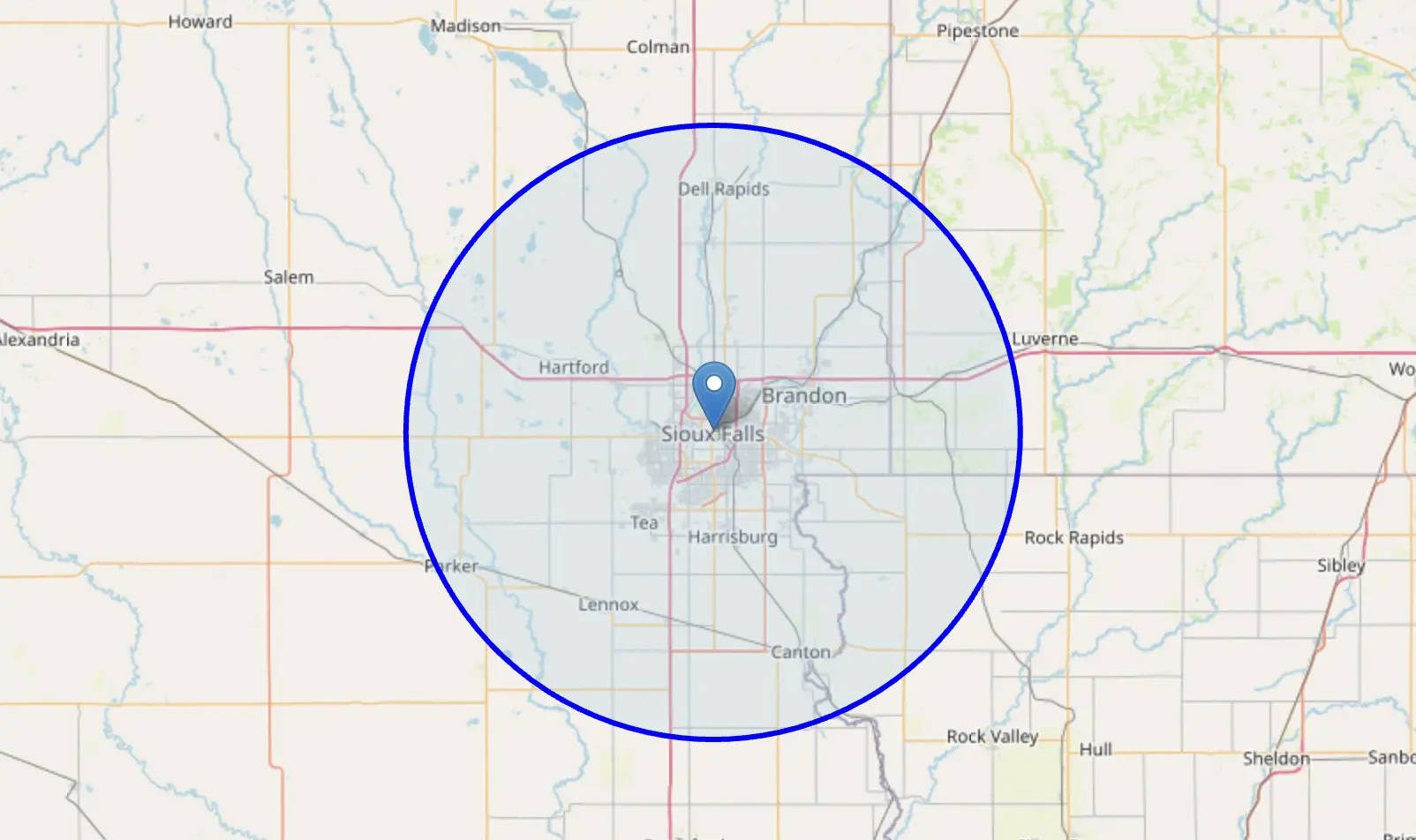
Find local details for each community on our service-area pages.
Frequently Asked Questions
Is radon really a problem in this area?
Elevated radon levels show up in homes across much of the country, and many regions test high often enough that the state radon program publishes local data. The only way to know about a specific home is to test it. Two houses on the same street can read very differently.
What is radon, in plain terms?
Radon is a naturally occurring radioactive gas that forms in the soil and rock under a home. It can enter through the foundation and build up indoors, and it has no color, smell, or taste. Public-health agencies, including the EPA, identify long-term radon exposure as a leading cause of lung cancer. That is why testing is recommended — it is a known problem with a well-understood fix.
What radon level requires action?
The EPA's action level is 4 picocuries per liter (pCi/L). At or above that number, the EPA recommends fixing the home. Between 2 and 4 pCi/L, the EPA suggests considering mitigation. These are published guidelines, and a test tells you where your home stands.
What does a radon mitigation system involve?
A mitigation system collects soil gas from beneath the home and vents it above the roofline before it can build up indoors. A typical system has a suction point under the foundation, a pipe run, a fan that runs continuously, and a small gauge that shows the system is pulling. The right design depends on the home's foundation and layout, which is what the assessment works out.
Does radon mitigation actually work?
Mitigation is a well-established fix. Systems are designed to bring levels below the action level, and a post-installation test is how the result gets verified. That retest — not a sales promise — is what tells you the system is doing its job.
Do I need to retest after mitigation?
Yes. A test after installation verifies the system brought levels down, and periodic retesting afterward is standard practice. The gauge on the system shows the fan is pulling, but only a test measures the actual level.