Radon Mitigation in Hartford, SD
A town with two housing eras
Hartford is really two towns wearing one name. There’s the railroad-era core: a grid of homes going back to the late 1800s and early 1900s, with the shallow basements of their day, block or stone walls, and floors poured long after the house went up, if at all. And there’s the Hartford of the last thirty years: subdivisions unrolling toward I-90, filled with poured-basement ranches and two-stories for families commuting into Sioux Falls.
Radon doesn’t prefer either era, but it enters them differently. The new stock behaves like new stock anywhere in the metro: tight envelope, full basement, predictable fix. The old core is where things get specific. A century-old house here has usually been improved a half-dozen times: a kitchen bumped out over a crawlspace in the 60s, a family room added on a slab in the 90s, a cellar section deepened somewhere along the way. Each project left another foundation type stitched onto the first, and each seam and section is its own doorway for soil gas. Mortared block walls, with their hollow cores and aging joints, add paths a poured wall doesn’t have.
For mitigation, that history matters more than the address. A one-suction-point default that works on a 2015 build can under-perform on a patched-together 1910 house, where the crawl under the kitchen keeps feeding the number even after the main basement is handled.
County-grain data is all anyone publishes. Minnehaha County rates EPA Zone 1, top of the potential scale, and the fuller picture sits at radon levels in your area. Old house or new, the test is the tiebreaker.
Matching the fix to the vintage
In Hartford’s newer neighborhoods, standard radon mitigation does standard work: slab suction point, clean pipe run, retest below the action level of 4 picocuries per liter. Straightforward.
The old core calls on more of the toolkit. Combined foundations often need crawlspace treatment — a sealed membrane over the exposed soil of that kitchen-addition crawl — tied into the same fan as the basement’s suction point, so the whole footprint gets pulled at once. It’s the difference between mitigating a house and mitigating part of one.
Testing runs through it all, in both eras. Hartford homes changing hands get monitored transaction tests inside the inspection window, and owners of the old squares, many of which have never been tested at all, are exactly the households the never-tested backlog is made of.
Coverage, stated plainly: this work runs out of Sioux Falls, and Hartford is about twenty minutes west on Highway 38 or the interstate. That’s a routine radius, where assessment, install, and the verification retest all schedule normally, no rural surcharge of patience required. Whether yours is an 1898 square with a stone cellar or a 2019 walkout on the edge of town, the sequence is the same: test, design to the actual foundations, fix, and prove it with a retest.
Our Services
-
Radon Mitigation
A mitigation system collects the gas beneath the home and vents it safely above the roofline — before it can build up indoors.
Learn more
-
Radon Testing
Radon can't be seen or smelled — a test is the only way to know a home's level.
Learn more
-
Radon for Home Sales
Radon findings in a purchase usually come with a deadline attached — the process works better when someone's done it on a closing schedule before.
Learn more
-
Radon Fan Replacement & System Repair
Mitigation fans run continuously for years — and like anything that runs continuously, they eventually wear out.
Learn more
-
Passive Radon System Activation
Many newer homes were built with a passive radon rough-in — a pipe that's ready for a fan but doesn't have one yet.
Learn more
-
Crawlspace Radon Mitigation
Homes over crawlspaces need a different approach — typically a sealed membrane over the exposed soil, tied into the venting system.
Learn more
Areas We Serve
- Sioux Falls
- Brandon
- Harrisburg
- Tea
- Hartford
- Crooks
- Dell Rapids
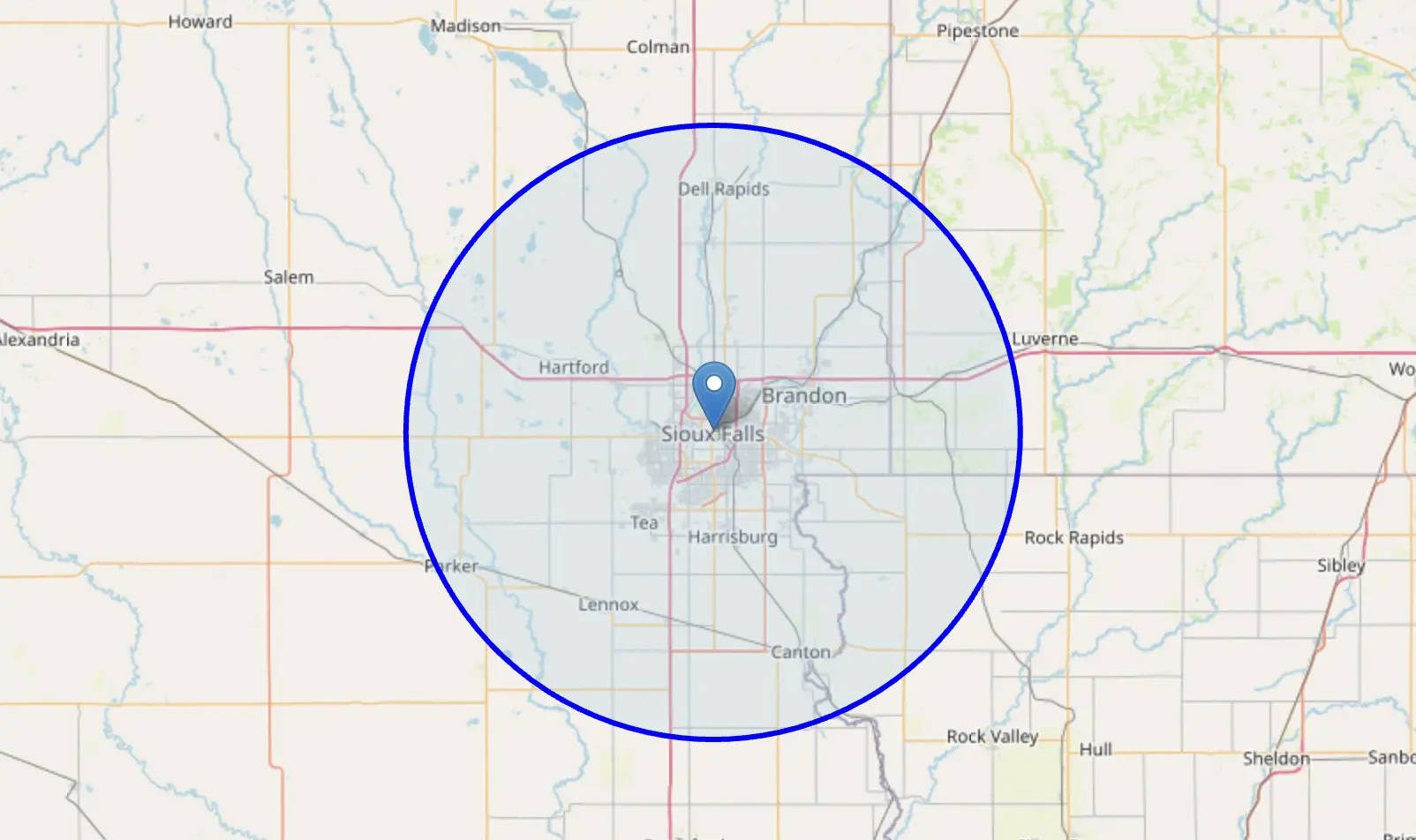
Find local details for each community on our service-area pages.
Frequently Asked Questions
Our Hartford house is a century old with an addition — does that complicate mitigation?
It's the most common complication here, and it's solvable. An addition often sits on its own slab or crawlspace next to the original basement, so the system may need suction on both sections to bring the whole house down. The assessment maps the foundations before anything is proposed.
Is there radon data just for Hartford?
No. Published data stops at county grain. Minnehaha County is EPA Zone 1, the highest-potential class, and elevated results show up in both Hartford's old core and its new subdivisions. Only a test speaks for a specific address.
Do you schedule work out in Hartford?
Yes. Hartford is about a twenty-minute drive west of Sioux Falls on Highway 38 or I-90. It books the same as metro work, including the follow-up retest visit.